
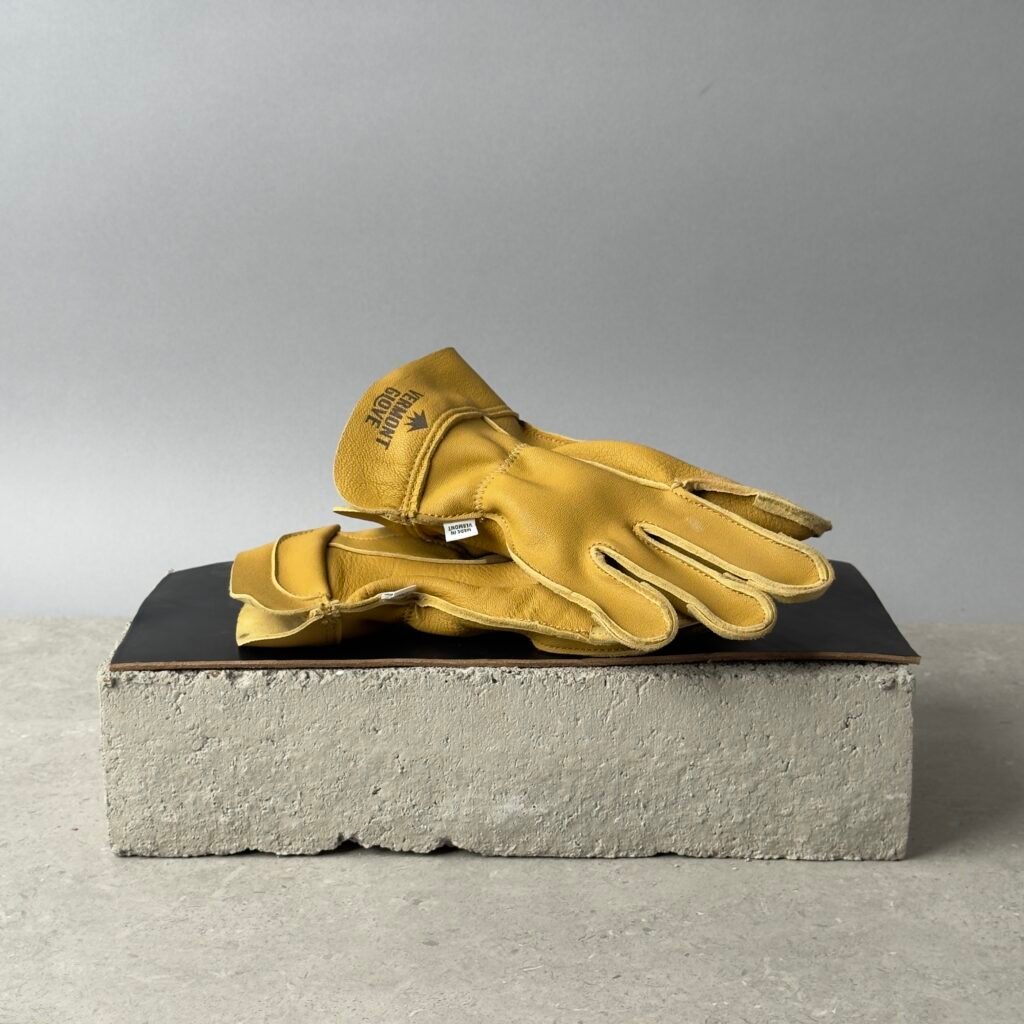
Product name: The Vermonter
Category: Leather work gloves
Brand: Vermont Glove
Country of origin: United States
Lost Art Gift Co. is reader-supported. Some links are affiliate links, meaning we may earn a small commission at no extra cost to you. We only feature products we stand behind.
QUICK VERDICT
Most work gloves are engineered around attrition. You wear them out, toss them, repeat. The Vermonter is built on the opposite assumption. It is a full goatskin leather work glove cut, stitched, and finished in Vermont using goat leather that the company has relied on for nearly its entire history. Roughly eighty percent of that leather is sourced from New England, with the remainder coming from Quebec. That regional supply chain matters. It reflects continuity and long term relationships rather than opportunistic material swaps.
The stitching uses tex bonded nylon thread, selected for abrasion resistance and tensile strength in high flex zones. This is not a cosmetic choice. It is a durability decision. The result is a glove that stays supple under hard use, can be repaired when necessary, and is intentionally built around service rather than disposal. Ownership here is not about keeping something clean. It is about committing to one pair and letting them earn their wear.
WHY THIS IS A TOP 50 GIFT FOR 2026
The Vermonter earns its place because it represents a category that is shrinking fast: daily use gear designed with repair in mind. Many products claim longevity while quietly assuming replacement. This glove does not pretend. It is made to be used hard. It is made to darken, soften, and mold to the hand over time. If stitching eventually fails, it can be restitched. The leather is expected to outlast the thread.
As a gift, this is not decorative workwear. It is a tool someone will reach for every weekend, every project, every cold morning outside. That consistency is what turns an object into something personal.
WHY THIS IS THE RIGHT CHOICE
The real hesitation people have is straightforward. They wonder whether a more expensive glove is simply a nicer version of something that still wears out too quickly. The Vermonter answers that concern in how it is built.
Vermont Glove has used goatskin for nearly the entire life of the company because of how it behaves under real conditions. Goat leather has a tight grain structure and high tensile strength relative to its thickness. It flexes easily, resists abrasion, and maintains softness even after repeated wetting and drying cycles. Cowhide, by comparison, often stiffens and becomes brittle over time. Goatskin breaks in without breaking down.
The tex bonded nylon thread is chosen for structural resilience. Bonded nylon resists abrasion and friction at stress points such as fingertips and seams. It tolerates moisture and repeated flexing without fraying prematurely. This is the type of thread used in industrial sewing applications where failure is not acceptable. When you understand those decisions, alternatives feel temporary by comparison.
MATERIALS AND CONSTRUCTION
The Vermonter is cut from full goatskin sourced primarily from New England, with additional supply from Quebec. That geographic sourcing is not incidental. It reflects a regional leather ecosystem and reduces dependence on overseas hides of inconsistent quality. The leather thickness is balanced for protection without sacrificing dexterity. You can handle small hardware, adjust tools, and tie knots without removing the gloves.
Patterning avoids placing seams in high abrasion areas whenever possible. Reinforced wear zones absorb friction where tools and handles contact the palm. The tex bonded nylon thread provides high tensile strength at stitch lines that see constant movement. Over time, the leather conforms to the hand, creating a fit that becomes more precise with use rather than looser and unstable.
Every construction choice points toward sustained utility. Nothing about this glove is ornamental.
REAL WORLD USE AND OWNERSHIP PERSPECTIVE
The first thing you notice is the absence of stiffness. The leather moves immediately. There is no cardboard phase. After being soaked from wet wood or damp soil, they dry without turning rigid. That matters more than people realize. Gloves that stiffen end up staying in the truck.
During heavy yard work and rough outdoor projects, I found I did not need to remove them to regain control. I could grip tools confidently and still manage smaller tasks. That balance between protection and dexterity is what separates a glove you tolerate from a glove you depend on.
When gloves disappear from your awareness while you are working, they have succeeded.
LONGEVITY AND LONG TERM OWNERSHIP
The Vermonter ages in a way that feels honest. The leather deepens in color and develops polish where it contacts handles and rough surfaces. The fit improves as the material molds to the contours of your hand. Over extended use, stitching may show wear before the leather fails. That is intentional. Thread can be replaced. Leather of this quality should not be discarded prematurely.
With basic care such as air drying after saturation and occasional conditioning, lifespan extends into years of consistent use. This is not theoretical durability. It is practical durability rooted in material choice and construction logic.
WHO THIS IS FOR AND WHO IT ISN’T
This glove is for tradespeople, gardeners, builders, ranchers, and anyone who uses their hands regularly and is tired of cycling through replacements. It is for someone who values repairability and does not mind visible wear.
It is not designed for chemical heavy environments where leather is the wrong material entirely. It is also not for someone who views gloves as short term consumables. The Vermonter assumes stewardship.
GIFTING PERSPECTIVE
Gifting The Vermonter communicates something specific. It says you see how someone works. It says you chose a tool built for repetition, not novelty. Gloves are rarely thought of as heirloom leaning gifts, but the right pair shifts that perception. These will not sit on a shelf. They will integrate into daily life almost immediately.
The memory forms not because they are admired, but because they are used.
COMPARISON AND TRADEOFFS
Compared to mass market leather gloves, The Vermonter costs more upfront. Compared to softer fashion oriented work gloves, it prioritizes durability and repair over refinement. The trade is clear. You pay more once. You care for the leather. You keep them in rotation instead of discarding them.
Once you step out of the replacement cycle, the math changes.
FINAL ASSESSMENT
The Vermonter is not a premium disposable glove. It is a deliberate alternative to disposable gloves. Goatskin sourced primarily from New England and Quebec, tex bonded nylon thread selected for abrasion resistance, and domestic construction in Vermont combine into a coherent philosophy. This is a glove meant to be used, repaired, and kept.
If you want one pair of leather work gloves you can commit to, this is the decision. Buy The Vermonter directly from Vermont Glove, choose your size carefully, and put them to work with the expectation that they will stay there for years. Check out our article, “Top 10 Gifts for Men,” here.