
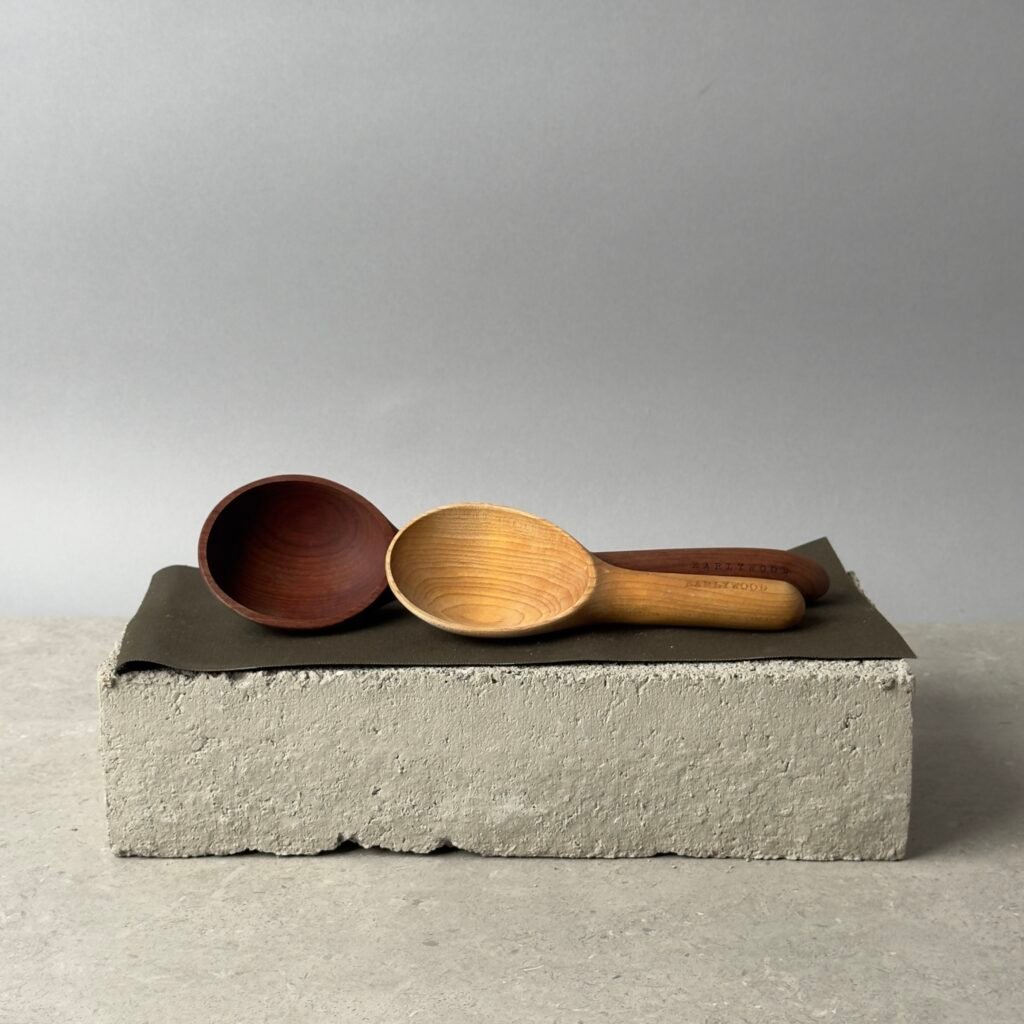
Product name: Earlywood Serving Spoon Set (3 Piece)
Category: Wooden serving spoons and ladle set
Brand: Earlywood
Country of origin: United States (Made in Montana)
Part of Our Kitchen & Table Permanent Collection
Lost Art Gift Co. is reader-supported. Some links are affiliate links, meaning we may earn a small commission at no extra cost to you. We only feature products we stand behind.
QUICK VERDICT
Most “nice” serving spoons are basically disposable: thin bowls that feel nervous in the hand, awkward handles that twist when you scoop something heavy, and finishes that go dull the first time someone “helpfully” runs them through the dishwasher. Earlywood built this set on a different assumption about ownership: that you’re allowed to keep a serving tool for decades, use it hard, and still want it sitting out on your counter. The set pairs their Classic Ladle, Long Server, and Short Server, each carved from a single piece of hardwood (jatoba or hard maple) and shaped around balance and grip instead of cuteness. If you cook for people, host even occasionally, or you’re replacing warped bamboo every year, this is the set that closes the search because it covers soups, stews, mashed potatoes, rice, and heavy sides without feeling precious or flimsy. You buy it once, you learn the simple care, and you’re done.
WHY THIS IS A TOP 50 GIFT FOR 2026
2026 is the year I’m watching more people reject the fake “upgrade cycle” in the kitchen. They’re not chasing a new gadget. They’re fixing the daily objects that quietly irritate them. Serving utensils are exactly that category: they touch every shared meal, then they disappear into a drawer like they’re not worth looking at. Earlywood flips that. This set earns its place because it turns the serving moment into something confident and orderly: each piece has a distinct job, each one feels intentional in the hand, and the whole set looks like it belongs to the kitchen you’re building for the long haul. Earlywood even talks about these as multi generation tools, and their “we will make it right” guarantee matches the posture of a brand that expects you to still own them later.
WHY THIS IS THE RIGHT CHOICE
Here’s the conclusion I landed on: a serving set only matters if it behaves well under real food weight. A ladle that tips when it’s full is annoying forever. A serving spoon that rotates in your grip turns every scoop into a small mess you didn’t need. Earlywood’s handle geometry is the tell. Both servers use a triangular cross section so your hand knows where the bowl is oriented without looking, which is exactly what you want when you’re moving fast at the table. Earlywood That design choice doesn’t photograph as loudly as “handmade,” but it’s what separates tools you keep from tools you tolerate.
Then there’s the way the three pieces cover the reality of hosting. The Long Server is the all purpose workhorse with a wide bowl that can pull a proper portion from dense dishes. The Short Server is built for smaller bowls and tighter angles, with a thick handle and a deeper, wider bowl than you’d expect from its compact length, so it doesn’t flip out of shallow servingware. The Classic Ladle is designed around balance and volume, and the maker describes it as just under three quarters of a cup level, which is exactly why it feels decisive when you’re serving soups and stews. Once you understand that each piece was shaped to prevent a specific kind of irritation, the alternatives stop looking like “savings.” They start looking like clutter you’ll replace anyway.
MATERIALS AND CONSTRUCTION
Earlywood offers this set in two woods: jatoba (Brazilian cherry) or hard maple. Jatoba is chosen for strength and shock resistance, with a Janka hardness listed at 2820, and it can darken with age in a way that reads like patina instead of wear. Hard maple is a classic North American abuse tolerant hardwood (think gym floors and butcher blocks) with a tighter pore structure and a lighter look, and Earlywood lists it at 1450 on the Janka scale.
The construction detail that actually matters is simple: these are meant to be maintained, not babied. Their care guidance is plain and strict: hand wash in hot soapy water, do not soak, do not use the dishwasher, and oil when the wood looks dry. They even describe their utensil oil as food safe mineral oil with a little lemon peel oil, and they include a scrubby packet so you can knock down fuzz and keep the surface feeling clean. That is the difference between “wood is cute” and “wood is a lifetime material.”
REAL WORLD USE AND OWNERSHIP PERSPECTIVE
This set is at its best when the table is actually busy. The Long Server is the piece you leave in the dish because it’s stable and easy to grab mid conversation. The Short Server is the one that saves you from chasing rice around the bottom of a bowl or awkwardly scraping with a dinner spoon, and Earlywood calls out that it won’t flip out of small or shallow bowls. The ladle is the mood setter: when a tool is balanced and sized right, serving stops being fussy. Earlywood’s own description focuses on that balance and comfort, and it shows up in the way they talk about testing the feel in hand before it goes out.
If your unspoken doubt is “wood is going to hold onto smells,” their approach answers it without drama: wash like a normal adult with soap and hot water, keep it out of the dishwasher, oil it when it dries, and the utensil stays clean and stable instead of turning gray and fuzzy.
LONGEVITY AND LONG TERM OWNERSHIP
A good wooden utensil doesn’t stay pristine. It stays present. With use, the edges soften, the surface evens out, and the wood starts to look like it belongs to your kitchen instead of a product photo. Earlywood is explicit about what ruins wood long term: dishwasher cycles, soaking, and neglecting oil until the fibers get thirsty and rough. Follow their five rules and the set becomes a stewardship object, not a purchase you re evaluate every year.
On the brand side, their guarantee is clear about the posture: they will replace issues tied to damage in transit or mistakes that slip through quality control, and they handle breakage as a case by case conversation rather than hiding behind fine print. That’s honest, and it’s still far more support than this category usually gets. The dishwasher rule is the hard line, and it should be.
WHO THIS IS FOR AND WHO IT ISN’T
This is for the person who cooks real food and wants tools that feel settled. It’s for someone who likes a clean counter and is tired of drawer junk that multiplies. It’s for hosts who notice the serving moment and want it to look composed without buying “decor.”
This is not for someone who insists every utensil must be dishwasher safe. Earlywood explicitly says the dishwasher turns utensils gray and fuzzy and voids the warranty. If that’s your lifestyle, skip wood entirely and buy stainless.
GIFTING PERSPECTIVE
This gift communicates something specific: I’m not buying you a trendy kitchen thing. I’m buying you the tools that show up when people gather. The set lands especially well for newlyweds, new homeowners, and the friend who always hosts but still uses mismatched utensils from three different eras. It’s also one of the rare gifts that can sit out on the counter and feel like part of the home, not part of a shopping binge.
COMPARISON AND TRADEOFFS
Compared to cheap bamboo sets, the tradeoff is cost, and it’s the correct tradeoff. Bamboo tends to be glued, thin, and short lived in the places that matter, especially at the bowl and handle transition. Earlywood’s pieces are purpose shaped for heavy food, and the sizes are stated plainly: Long Server is 11.5 x 3.2 x 0.8 inches, Short Server is 8.5 x 3.5 x 1 inches, and the Classic Ladle is 13 x 3.5 x 1.9 inches.
Compared to metal, the tradeoff is maintenance. You must hand wash and oil occasionally. In exchange, you get a warmer feel in the hand, no scraping against cookware, and a serving set that ages visually instead of looking “used up.”
FINAL ASSESSMENT
If you want one serving set you can stop thinking about, this is it. Earlywood’s Serving Spoon Set is built around grip, balance, and real food weight, then backed by care guidance and a brand guarantee that treats long term ownership as normal. Once you decide you’re done buying disposable kitchen tools, there’s no reason to keep shopping past this set.
Go straight to the Earlywood Serving Spoon Set product page and choose your wood: jatoba for deeper color and extra hardness, hard maple for the classic light look. Check out our article, “How to Choose a Gift That Lasts a Lifetime,” here.